



Background
The technology sector supports job growth, entrepreneurship and productivity. It is one of Australia’s fastest growing industries, and advances in technology will continue to drive demand for the sector as consumers and businesses adopt new applications and processes. The technology sector on the Gold Coast has expanded at a faster rate than for Queensland or Australia, as evidenced by the growth in the workforce since 2011. Over the five years to 2021, the local technology sector workforce increased at an annual average rate of 4.7%, higher than Queensland and Australia (3.3% and 3.1% respectively). The City of Gold Coast’s contribution to the state and national technology sector continues to grow. In 2011, 8.7% of Queensland’s technology sector workforce was located on the Gold Coast. This has now increased to 9.8%, in other words, one in ten of Queensland’s technology sector workers are employed on the Gold Coast. The Gold Coast accounts for 1.3% of Australia’s technology sector workforce, a proportion which has remained constant over the past decade (1.2% in 2011).
Project goals
This report and supporting analysis have been prepared at the request of the City of Gold Coast to understand the economic contribution of the technology sector, now and into the future. The report presents a variety of economic indicators that demonstrate the increasing significance of the technology sector in supporting economic growth and prosperity.
REMPLAN’s involvement
REMPLAN was commissioned by the City of Gold Coast to prepare a Technology Sector report to understand the economic contribution, now and into the future. REMPLAN used REMPLAN Economy to estimate the scale and contribution of the sector across key economic metrics, drawing on established industry classifications and local intelligence.
Results
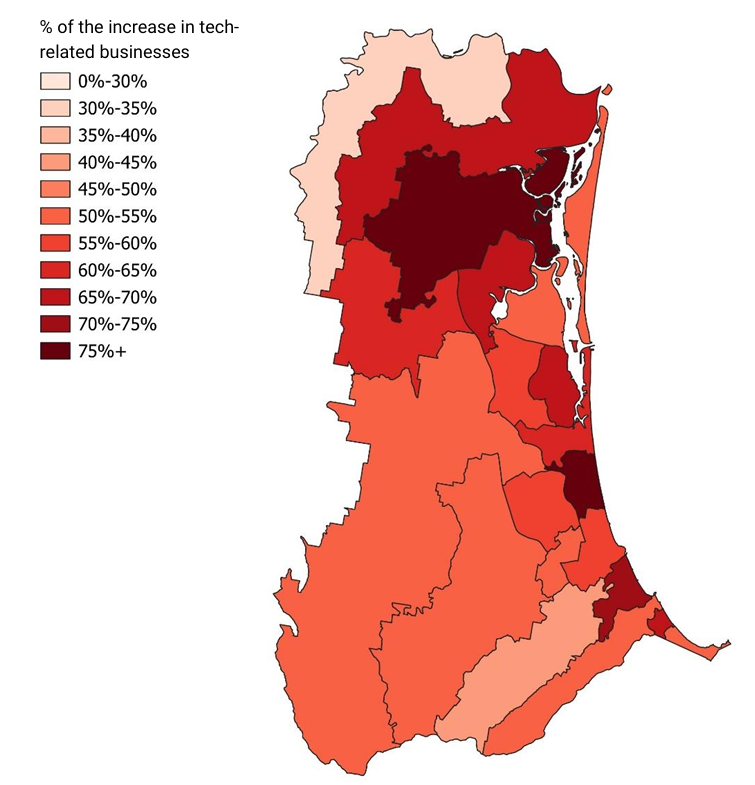
The Gold Coast technology sector generates a total economic impact of $7.5 billion in output, with each job supporting an additional 1.5 jobs in the local economy. Over 18,000 businesses operate within technology industries. While technology adoption may disrupt traditional industries, it will drive productivity and economic growth for Australia. Education and workforce re-skilling are key to avoiding long-term unemployment and inequality. The Gold Coast technology sector worker productivity lags behind some benchmark regions, but local supply chains are well-developed.
By 2032, the total economic impact is forecast to include $9.7 billion in output, $4.6 billion in value-added and 20,500 jobs.