


Background
The Gold Coast is experiencing sustained employment growth across key economic sectors, alongside escalating housing costs and tight rental market conditions. These pressures are increasingly shaping the City’s ability to attract, retain and replace workers, particularly in lower- and middle-income industries that underpin tourism, retail, construction, health and education. The Gold Coast Regional Jobs Committee required a clear, evidence-based understanding of how housing affordability interacts with workforce sustainability across the Gold Coast. Existing housing and labour market indicators provided partial insights, but there was no integrated framework linking housing costs, commuting burdens, industry income structures, demographic change and long-term economic capacity. This project was commissioned to fill that gap by delivering a policy-focused analysis that translates complex data into practical insights to support advocacy, planning and funding decisions.
Project goals
The primary objective of the project was to assess how housing affordability affects workforce attraction, retention and replacement across the City, and to identify where affordability pressures pose the greatest risk to long-term economic growth.
Specifically, the project sought to:
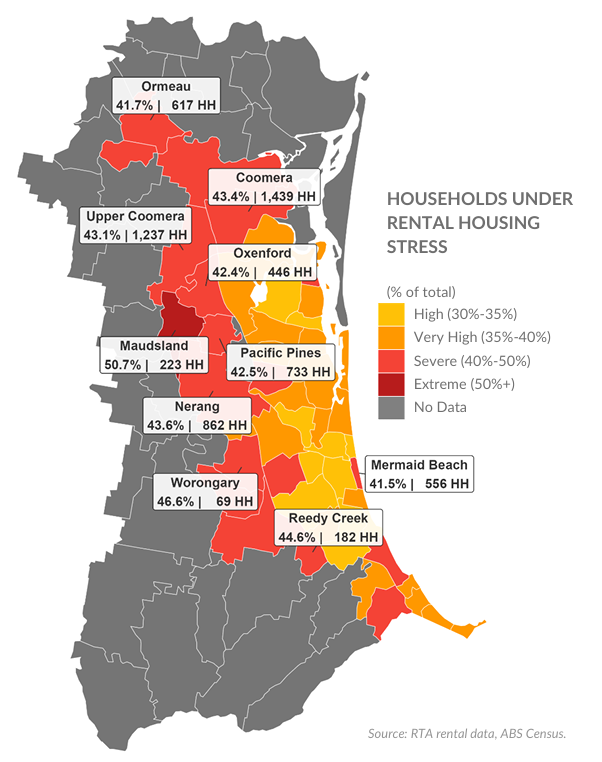
- Quantify the scale and geography of housing stress across households and workers.
- Identify industries and occupations most exposed to affordability pressures.
- Examine spatial mismatches between employment hubs and affordable housing supply.
- Assess the combined burden of housing and transport costs on workers.
- Understand how affordability pressures interact with demographic change and workforce ageing.
- Test what different levels of policy intervention might achieve in addressing workforce housing gaps.
The final output needed to be accessible to decision-makers while retaining analytical rigour, enabling the findings to be used directly in policy development, funding advocacy and strategic planning.
REMPLAN’s involvement
REMPLAN delivered a multi-module analytical program integrating housing market data, workforce economics, spatial analysis and demographic modelling.
Key elements of the work included:
- A dual-tier affordability framework assessing both household housing stress and individual worker affordability using industry income benchmarks.
- Industry vulnerability scoring to identify sectors most at risk from housing affordability pressures.
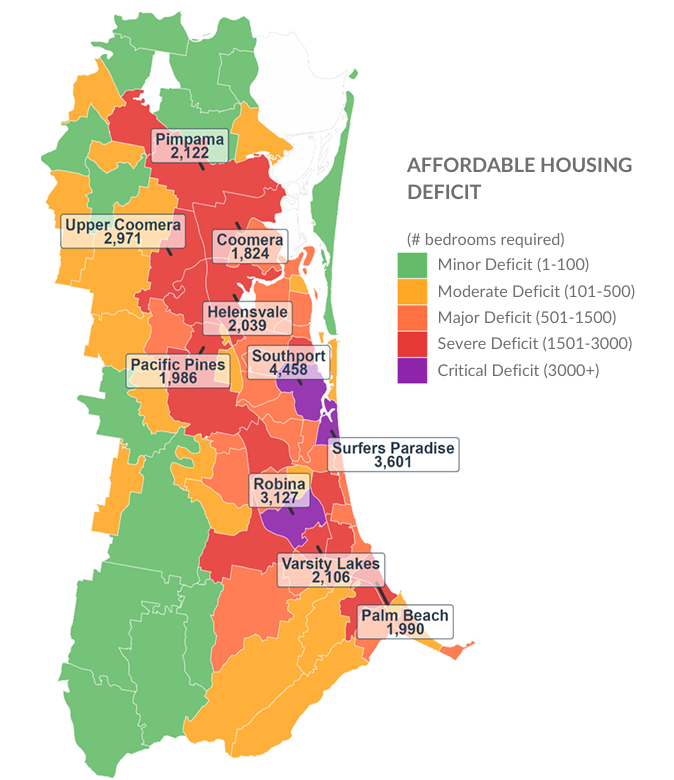
- Spatial analysis mapping employment hubs against affordable housing supply to quantify housing deficits and commuting distances.
- Journey-to-work analysis capturing the combined impact of rent and transport costs on workforce accessibility.
- Demographic analysis examining population churn, workforce ageing and the capacity to replace retiring workers.
- Market dynamics analysis exploring the relationship between employment growth and rental market tightness.
- Policy scenario modelling to test the scale of housing supply or affordability interventions required to meaningfully reduce workforce housing stress.
All analysis was grounded in multiple validated data sources, including REMPLAN Economy data, ABS Census data, rental bond statistics and property market data, and was designed to prioritise clarity and policy relevance over technical complexity.
Results
The analysis confirmed that housing affordability is a material constraint on workforce sustainability across the Gold Coast.
Key findings included:
- Approximately 125,000 workers are spending more than 30% of their income on housing, indicating widespread workforce housing stress rather than a marginal issue.
- Several large employment sectors, including Accommodation and Food Services, Retail Trade, Construction and Education, face heightened vulnerability due to the combination of housing stress and workforce scale.
- Housing stress is highly spatial, with coastal and tourism-focused employment hubs experiencing the most severe mismatch between job locations and affordable housing supply.
- In multiple employment hubs, workers must search well beyond reasonable commuting distances to find sufficient affordable housing, increasing transport costs and total living burdens.
- Prime working-age cohorts are more likely to leave areas with high housing stress, compounding workforce replacement challenges as a significant share of the existing workforce approaches retirement.
- Modelling indicates that housing availability acts as a long-run constraint on employment growth, with labour markets adjusting when housing pressures intensify.
- Policy scenario testing demonstrated that small-scale housing interventions deliver limited impact, while meaningful improvements to workforce housing outcomes require sustained, large-scale supply or affordability measures.